
Tuesday, September 22, 2015

The Shop Local Initiative: The Thing About Demographics


This blog is the third in an ongoing series of featured posts on Shop Local initiatives in the United States. In this post we talk about demographic shifts and how shop local activities need to move with the times.

Over the past few years there have been many changes to the landscape of small business. For example, from 2007 to 2012 the percentage of business owners age 50 and older rose five percent to 51% while business owners age 35 to 49 fell from 39% to 33%. The majority of small business owners are getting older.

In addition, a study by Pew Research Center cited that only 65% of adults aged 50 and above use social media. That means that 35% of older adults have never used social media before in any capacity.  Small business owners are getting older and are less likely to engage in social media.

In the meantime, a large portion of today’s customers are Millennials (people born from the early 1980s to early 2000s). According to Oracle, Millennials will spend $2.45 trillion in 2015 and that by 2018 they will have surpassed baby boomers in spending with $3.39 trillion. Millennials are also relying more heavily on mobile to make their purchases. According to Edelman Media, 41% of them make purchases on mobile devices. For Millennials, the smartphone has become the new hub of shopping.

Making matters more complex, Millennials are not as susceptible to advertising as previous generations. A staggering 48% of Millennials rely on casual conversations with friends, view postings on social media such as Facebook, read shout outs on places like Twitter, or just 'google' names on the internet before purchasing a product. Sixty-two percent of Millennials actually want to engage with the brand on social networks (alas, not so much for the older generations).

According to Forbes, this hyper-social behavior creates extreme brand loyalty. Social media is an important part of advertising and promoting business. Not using it for your small business puts you at a huge disadvantage in today’s competitive market.

However, not many small businesses are ready to take advantage of the spending power of the Millennial demographic. According to the Small Business Association, 93.3% of small businesses websites are not mobile compatible. This makes it difficult for the average Millennial to shop for your goods on their mobile device.

While you are digesting those numbers, think of the other struggles the small business demographic is facing. More than 22 million of the 28 million small businesses in the U.S. are self-employed and have no additional employees. They are known as non-employers. These individuals form about 75% of all U.S. businesses and are continuously growing with approximately 543,000 new businesses starting each month.
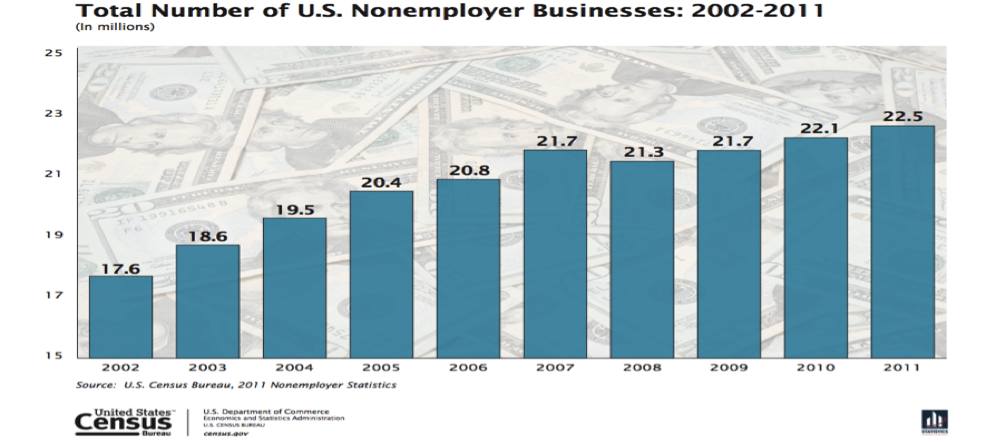

However, this growth is not necessarily a positive sign as more small businesses shut down than start up each month. The new businesses that are popping up are essentially just replacing the ones that have closed down.

Forbes pointed out that 7 out of 10 new employer firms survive at least 2 years, half at least 5 years, a third at least 10 years, and a quarter stay in business 15 years or more. Half of all new businesses tend to close down after 5 years, which is not a sustainable number for a continuously evolving economy. These businesses shut down for many reasons including competition, lack of sales, lack of awareness, and, most importantly, lack of customers. Larger e-commerce companies are kicking out these small businesses by creating better deals or a better convenience!

So how can small businesses make themselves more attractive to Millennials?

First, they need to get online.  According to the marketingtechblog, 8 out of 10 small businesses do use social media to drive their business and gain new consumers. Digital is becoming a crucial part of the shopping experience and businesses need to be in position to engage consumers where they want and at any time they want.

Second, they need look for a cost effective way to create a mobile presence.  Many small business owners simply turn away from going online because it is too complicated or it is too complex or they think local foot track will keep them going.  By engaging online, small businesses will be able to further their sales, increase awareness among the Millennials, and remain competitive.

The one constant in this world is change.  Today's demographic is tomorrow's statistics. Small businesses need to continue to react and evolve to their ever-changing customers and a solid online and social media presence is a great way to keep up with your demographics.


Sources:
http://www.forbes.com/sites/jasonnazar/2013/09/09/16-surprising-statistics-about-small-businesses/
https://www.americanexpress.com/us/small-business/openforum/articles/small-business-owner-demographics-are-changing-sba-report-says/
https://www.sba.gov/content/demographics
http://www.pewinternet.org/data-trend/social-media/social-media-use-by-age-group/
http://www.forbes.com/sites/danschawbel/2015/01/20/10-new-findings-about-the-millennial-consumer/2/
https://smallbusiness.yahoo.com/advisor/22-shocking-stats-millennials-help-chart-tomorrow-change-112531305.html
https://www.marketingtechblog.com/2014-statistics-trends-businesses-social-media/
http://www.slideshare.net/DataNCharts/slideshare-online-vs-offline-word-of-mouth-what-drives-consumer-purchase-decisions

#shoplocal #smallbusinesssaturday #pixiboard       

About the Authors

 Sean Brown is the Founder of Pixiboard and an advocate for making local commerce safe and seamless for buyers and sellers alike.


Barisa Abidin is a marketing intern at Pixiboard and a senior at University of San Francisco


Monday, August 24, 2015

The Shop Local Initiative: Why Shop Small Saturday is Not Enough

This blog is the second of an ongoing series of featured posts on Shop Local initiatives in the United States.  This post, Why Small Business Saturday is Not Enough, reviews the limits of current efforts.
Small Business Saturday (SBS) is a shop local initiative that is done in many cities to promote the local businesses in the area. SBS was created by American Express in 2010 to help local shops get more customers.  Targeting the Saturday after Thanksgiving, it serves as a counterpart to Black Friday and Cyber Monday.

Black Friday and Cyber Monday feature big box retail and e-commerce stores respectively. By contrast, SBS encourages holiday shoppers to patronize brick and mortar businesses that are small and local.  Shopping small and local leads to a number of benefits for the community, as depicted in the graphic below.

Source:CapeGazzette.com
For example, many small businesses experience an increase in their sales and customer base through the yearly SBS initiative. BeBodySmart.com, an eCommerce retailer that sells athletic apparel and fitness equipment, reported an increase of 900 customers due to Small Business Saturday. Other stores such as Kidz Enterprise Toys increased their sales by 126% due to the initiative.
However, SBS does have its limitations.  First, SBS only takes place once a year.  While traditionally Black Friday was when many businesses finally turned a profit, businesses would like to spread sales out year-round.  Second, the initiative exclusively features only small businesses that accept American Express.  Many small businesses do not carry American Express due to higher transaction fees or can’t afford to give rebates to new customers to promote the event.  Finally, for those who participate, much of the sales activity and interest disappear once the SBS promotion ends.  It would be nice to have customers think about local stores all around the calendar.
So what is next?

Is the SBS initiative alone really is enough to continuously support small businesses?

If so, how can this initiative be expanded to include more small businesses?
To answer those questions, we must understanding the factors currently at play.  Small businesses face tough challenges today due to competition from large retailers that have expanding in major cities and towns and online retailers that are open 24x7.  These "mom-and-pop shops" depend mostly on word of mouth and actual store visitation in order to make profits, which is different compared to other major retailers who use online ads and personalized websites to promote their products successfully online.
In 2015, 21% of the revenue from the $63.5 billion online advertising industry is coming from the retail sector.  This shows that large retailers are spending a good chunk of their resources on advertising their products online and thus effectively pushing the “little” guy out of the market.  At the same time, only 51% of small businesses have a website online.  And 93.3% of those small business websites are not mobile compatible.  Small businesses are losing out to larger retailers due to the lack of online presence and awareness!

Small businesses need to have the tools to fight back.  To expand participation and frequency of the SBS initiative the following steps must be taken:
  • Offer cost-effective, online marketing capabilities that enable small businesses to promote their brand/products to compete with online retailers
  • Democratize and simplify the ability to create online storefronts enabling all small businesses to have a web/mobile presence
  • Create a new medium that make it easy for consumers to find small businesses in each market regarding of which channel they use
  • Create a transactional platform that allow small businesses to participate regardless of what credit cards they accept
  • Expand/create a new small business initiative to encourage local purchase on monthly or weekly basis
Small Business Saturday and other similar campaigns are great initiatives that bring meaningful impact to small, local businesses.  But they are only a start.  These initiatives must be improved upon and expanded in order to compete with the aggressive advertising tactics of large retailers and the encroachment of online retailers.

By expanding the SBS initiative and helping small businesses create an affordable, seamless, cross-channel presence as suggested above, businesses can ensure that they reach potential customers who can only be tapped online or start their shopping experience on the internet.  In doing so, small businesses can create a sustainable customer base which will allow them to operate and help their communities for the years to come.
So in the spirit of Small Business Saturday, go out there and support your local businesses today!

Sources:
http://grasshopper.com/resources/articles/small-business-saturday-statistics/
http://www.statista.com/

#shoplocal #smallbusinesssaturday #pixiboard
About the Authors
Sean Brown is the Founder of Pixiboard and an advocate for making local commerce safe, easy and seamless for buyers and sellers alike.


Barisa Abidin is a marketing intern at Pixiboard and a senior at University of San Francisco.


Thursday, August 6, 2015

The Shop Local Initiative: Why Shop Local?

This blog is the first of an ongoing series of featured posts on Shop Local initiatives around the country. The objective of this series to outline the benefits and challenges of current Shop Local efforts as we consider alternatives to expand successful, but limited, initiatives such as Shop Small Saturday. Our first post, Why Shop Local, serves as a primer for our future posts by first outlining the economic impact of local shopping.

Shopping is intrinsically local. eMarketer estimates that a relatively small portion of retail sales – roughly 7.1% in 2015 – will take place online. So when people think of Shop Local they usually think about shopping at any nearby store and buying products within the city itself.

Shop Local, however, is more than that. Shop Local is about supporting the small businesses that make up the majority of economic activity within a city. According to the Andersonville Study of Retail economics, small businesses generate almost 70% of local economic activity. Without spending at these businesses, the local economy would fall. The disadvantages for the city are depicted in the graphic below.
Source: Localfirst.com

The majority of money spent at small businesses flows back into the local community. According to the American Independent Business Alliance (AMIBA), every dollar spent at a local independent merchant generates 3.5 times as much wealth in the local economy as a dollar spent at a chain-owned business. The reason behind this is that as local businesses become more successful they create more jobs within the community in the form of suppliers, distributers, and more.

There are more than 28.2 million businesses operating in the United States, according to a 2014 article in Forbes Magazine. Sixty-three percent of the new jobs created between 1993 and 2013 were from small businesses. Small businesses have a great impact on the number of jobs created within a local community. Some may say that larger and more established stores can create more jobs in an instant, however, consequently they can also lay off a large amount of workers at a single notice without any consideration. Local stores on the other hand are much more considerate as they are run by locals from the community.

In summary, local businesses provide a large amount of economical benefit to the society and we should work hard to support them in every way. They create and sustain many jobs for the community while also giving back in many, many ways.  Get out there and shop local.

Sources:

#shoplocal #pixiboard
About the Authors
Sean Brown is the Founder of Pixiboard and an advocate for making local commerce safe, easy and seamless for buyers and sellers alike.


Barisa Abidin is a marketing intern at Pixiboard and a senior at University of San Francisco.


Thursday, May 7, 2015

If You’re Reading This, You Should Probably Call Your Mom

Last month I was at Jack White’s set at Coachella. It is an understatement to say that I was in a euphoric state at the time, considering that I am a lover of his music combined with the fact that he was absolutely killing it. But my mood switched from being euphoric to being a tiny bit emotional. In between sets, he said something that really made an impact on me. He encouraged the crowd to contact their parents.

“They miss you and they are probably worried about you. Just give them a call."

It hit the crowd like a bomb. Everyone could relate to what he just said.

We all get caught up with our own individual lives, in this individualistic society. It is often too easy to forget that we actually have parents that have gotten us to where we are today. And still a lot of us, including me, do not find the time to contact them as much as they would probably want us to.


I had not spoken to my mom in a while. She lives on the other side of the world. I know that it is easy with modern technology to send her a message or give her a quick phone call. But I often find excuses for myself for not contacting her as much.

For instance, the 9 hour time difference is very annoying.  She would already a sleep when I want to contact her. Or, I do not want to bother her when she is at work. I feel bad about my constant excuses. I work hard to change my habits. That is why I am thankful for days like her birthday or Mother's Day - they remind me to do something special for her. Something which she strongly deserves.

I used to think that Mother's Day was a lame commercial holiday, created by corporate companies as an excuse to make us spend more money. I still think it is, but it does give us a very good reason to reach out to our moms, give her a phone call, send her a gift, take her out for dinner, and make her feel loved.  Thanks to Mother's Day, we can put a smile on her face every year and show her the love she needs. Now I can truly see the positive side of this holiday. Thanks for that, corporate America!
 

This year I want to send my mom a really nice gift and I encourage everyone reading this to do the same (if you weren't already planning it). It can be a difficult task to find a good gift for mom with a low budget. Luckily we do have some nice things on Pixiboard that she might love!

I know my mom would love all the stuff that the Apron Guy sells. He has a great selection of household items. I know this sounds like a generalization, but to be honest, moms just love that kind of stuff (at least mine does).  It is a mystery how excited she can get over a bunch of kitchen towels, but hey what works works. Check out a few of his pieces, like this $6 pear kitchen towel , or this matching $5 shopping bag, or this cute cupcake apron that mom will rock, or even these awesome waffle drying towels that are super handy to put washed dishes on.
 
 
Is your mom not the house'y type? Maybe she would like something to make her feel pretty. These Moroccan slippers just got posted on the board and I honestly love them. They look super comfy as well. Or maybe she would adore this Moroccan vase, which is a bit on the pricier side, but at least it is something that will last forever.


So if you haven't found a perfect gift for mom yet, check out Pixiboard. There are many local offerings from small businesses in the Bay Area.  From most, you can order online and pick-up at the store.

Of course, if it is too late to get that perfect gift, there is always the phone call.  Pick up the phone, call your mom, and tell her how you feel.


Happy Mother's Day, mom!

#mothersday #pixiboard #shoplocal